Valentin Luke Stehling

Get in touch

For bookings, collaborations, or questions about a project:

info@valentinlukestehling.com +49 157 5793 7686
About

Light That Transforms Spaces

I build light art that you feel before you understand it: floating LED planets, stage light that breathes with the music, installations that make people stop in their tracks. Everything is made by hand, from the first sketch to the last solder joint – including the control systems, which I program from scratch for every project.

For festivals like Fusion, Skalar, and Bucht der Träumer I've built stages, developed lighting concepts, run entire floors of LED installations, and performed live as a VJ. With the Hampelkammer collective, my work was recently on display as a publicly funded art project in two Berlin subway stations. For clubs, events, and spaces I design complete lighting concepts – from the idea through the build to the control system, tailored to the place and the feeling it's meant to create.

You've got a room, a stage, a vision? Let's build something big.

Light Installations Stage Design & VJing Custom-Built LED Objects Festival Production
Installationen 2026

Cosmic Sinkhole

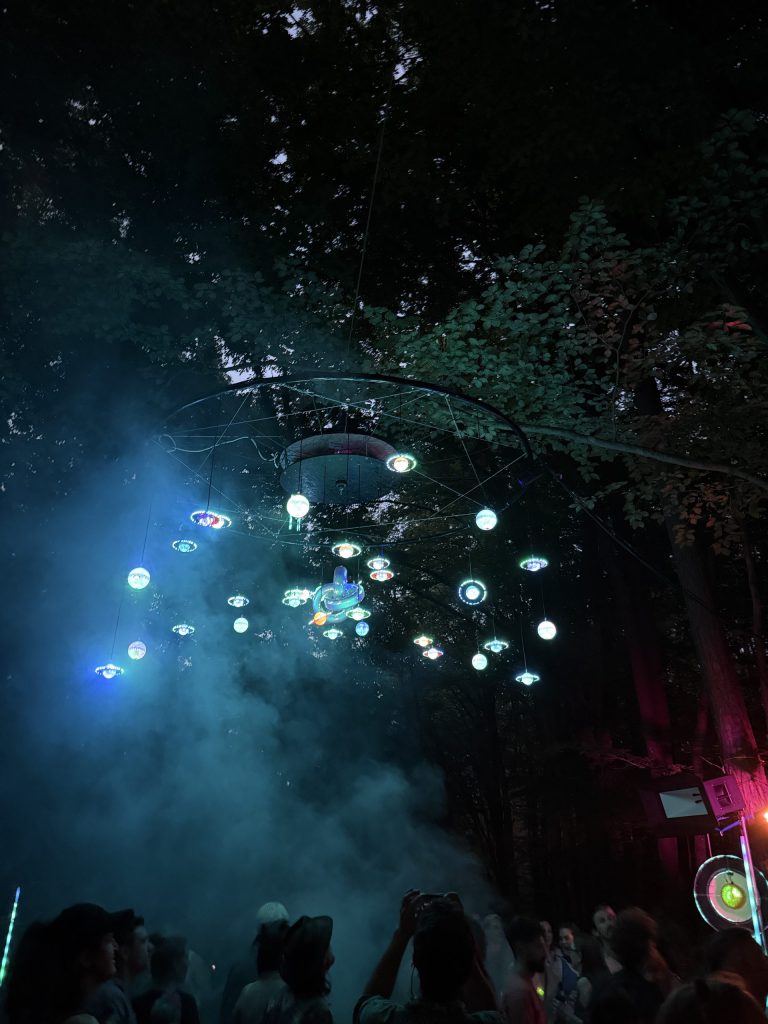
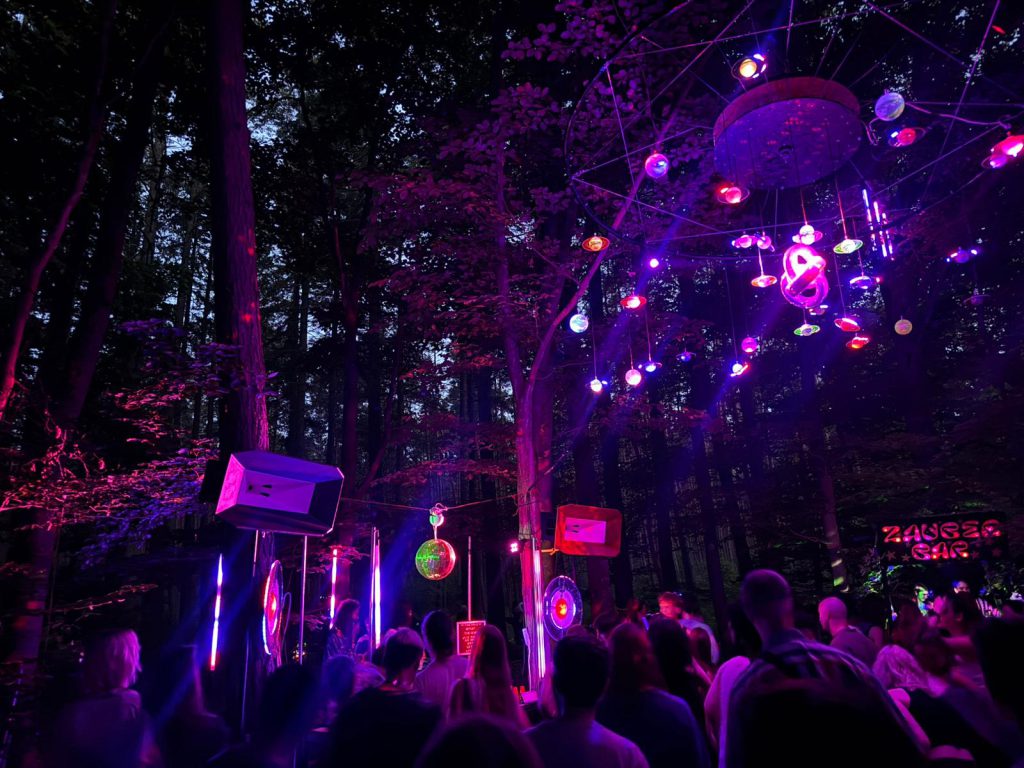
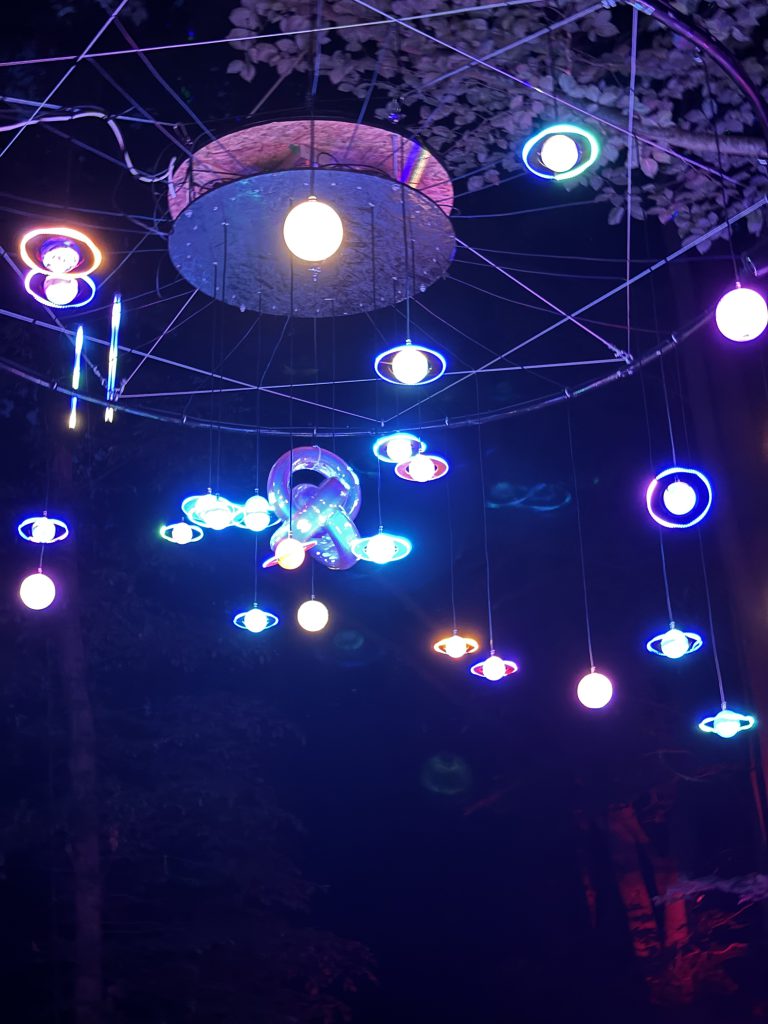
A little universe to lose yourself in: 32 floating planets, over 4,600 LEDs, and a disco ring-node at its center – suspended between two trees in the forest.
Cosmic Sinkhole is a little universe in which you lose yourself. The name says it all: whoever stands beneath it is drawn in and stays. The dance of the lights pulls you inward, until the rest of the world disappears for a moment.

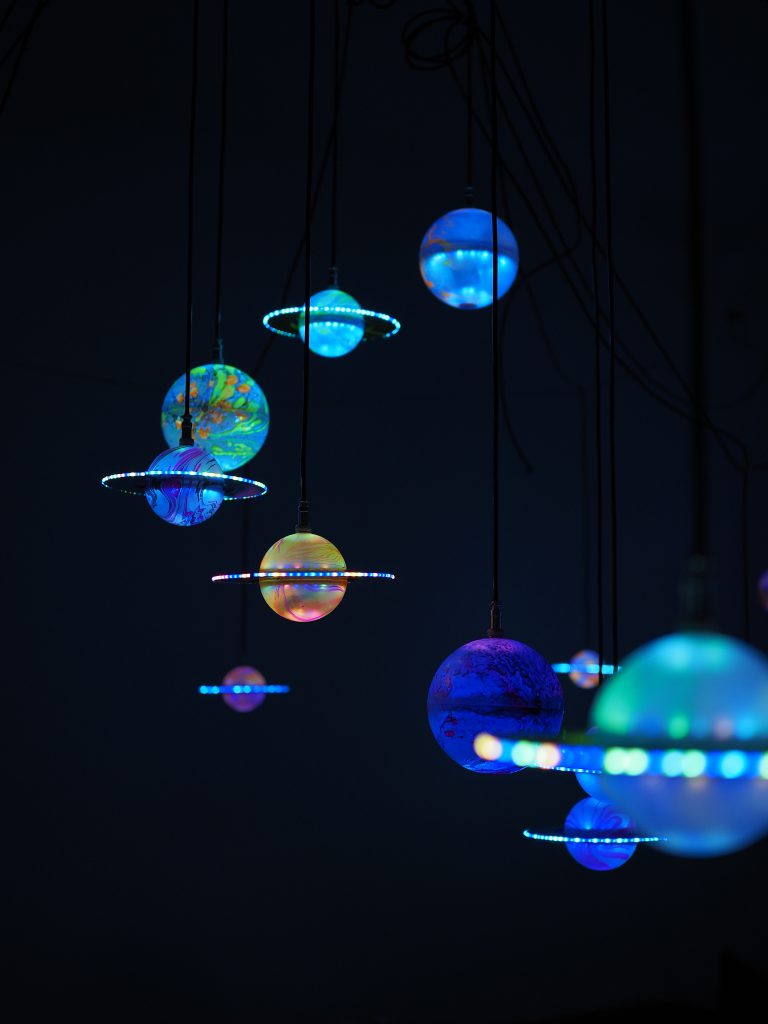
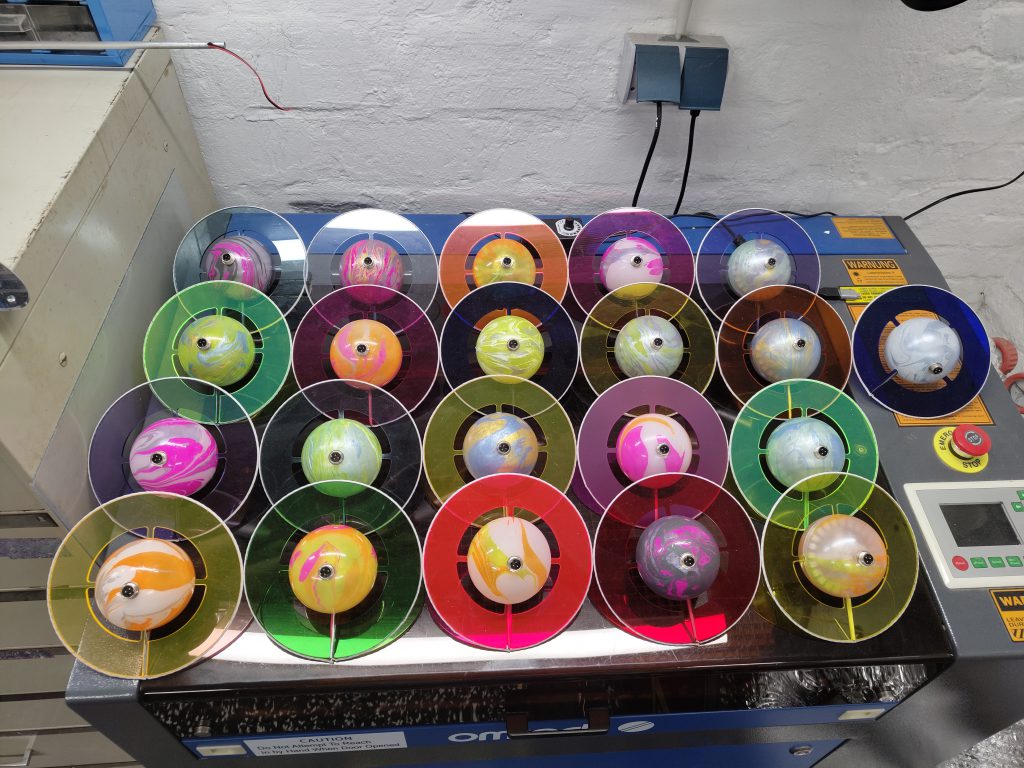
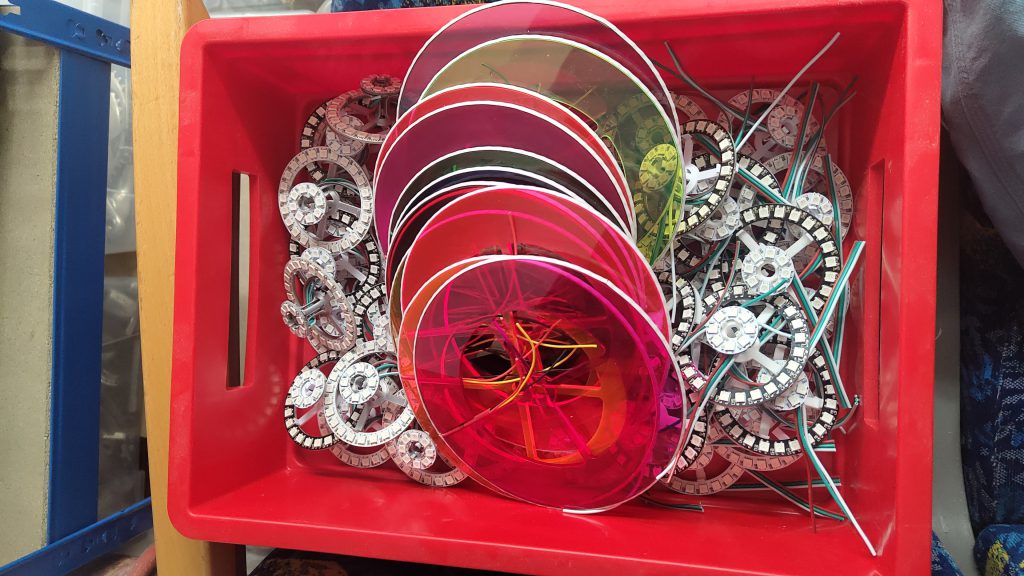
32 individually built planets float in three concentric orbits, driven by over 4,600 addressable LEDs. No planet is like any other: each one is marbled and painted by hand, every acrylic disc colored differently – a field of pure one-offs that looks completely new depending on the angle and the effect. Across the three orbits, lights travel, circle, drift, and dissolve into one another.

At the center sits the ring-node – the sun of this system. A large disco-ball core that Tina Reuter (Hampelkammer) covered mirror by mirror in painstaking detail. Wrapped in fog and roaming spotlight, it throws thousands of reflections into the room and gives the installation its pulsing heart.

The whole thing – around 80 kg – is held by steel cables strung between two trees. A 1-meter steel ring forms the structural and technical heart: this is where the “brain” sits, from here the cables run outward like a star to the individual planets, and the 3-meter outer ring is tied to a central point by steel cables. The real challenge was above our heads: to get the load-bearing cables into forked branches more than ten meters up, we shot them up with a large slingshot – the trees protected with tree slings, the entire rigging secured together with an industrial climber and his equipment. Whether it would all work was uncertain beforehand. But because I’d been able to fully assemble and test the frame on my parents’ attic in advance, setup and teardown on site went off smoothly.

Cosmic Sinkhole is controlled via four WLED controllers over Art-Net, plus two DMX spotlights and a controllable disco motor that keeps the ring-node in motion. The installation is modular and adapts to different spaces and occasions – whether a forest dancefloor, a club, or an exhibition.

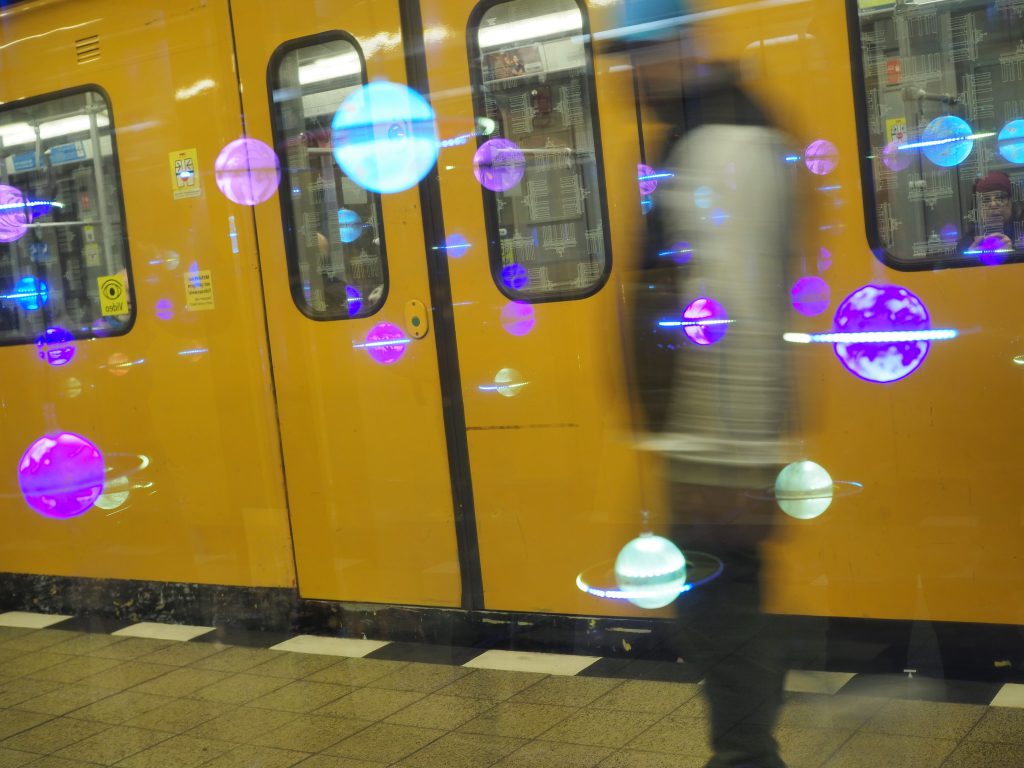
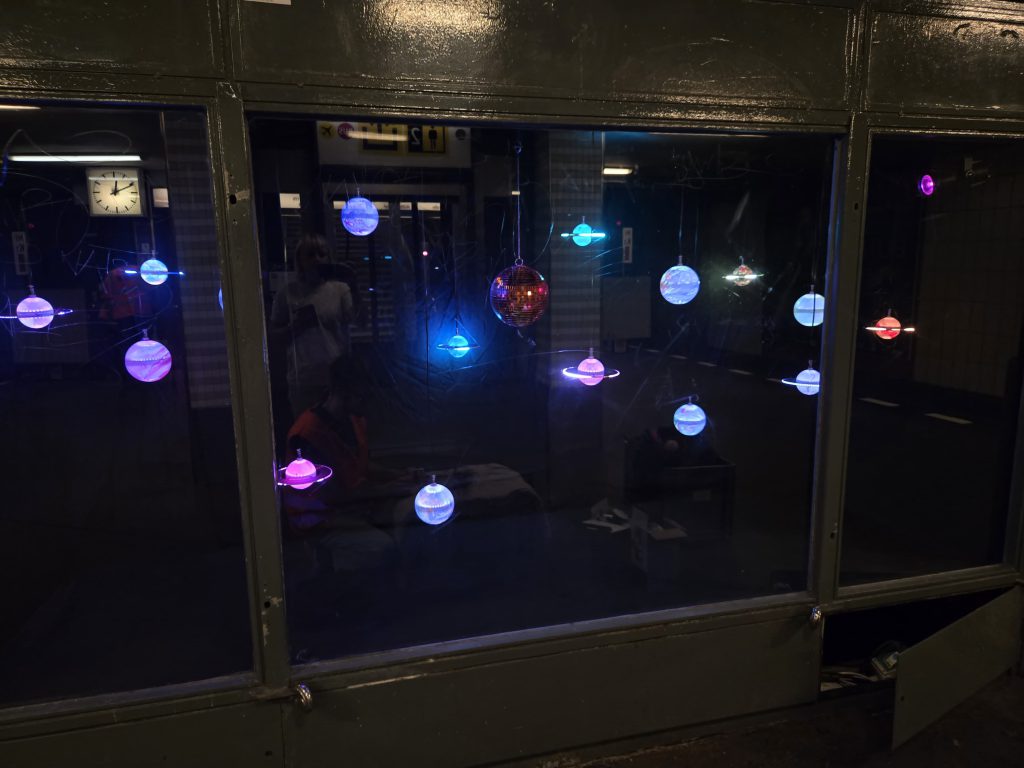
Traumraum Alt-Mariendorf – schwebende LED-Planeten in der U-Bahnhof-Vitrine
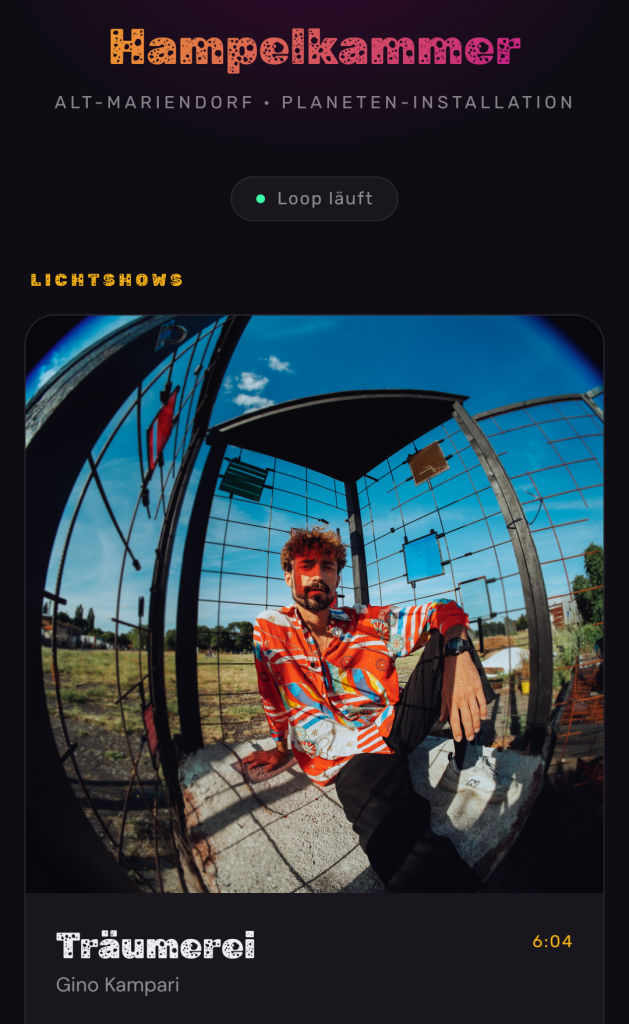
Traumraum Alt-Mariendorf – Web-Oberfläche für die Lichtshow
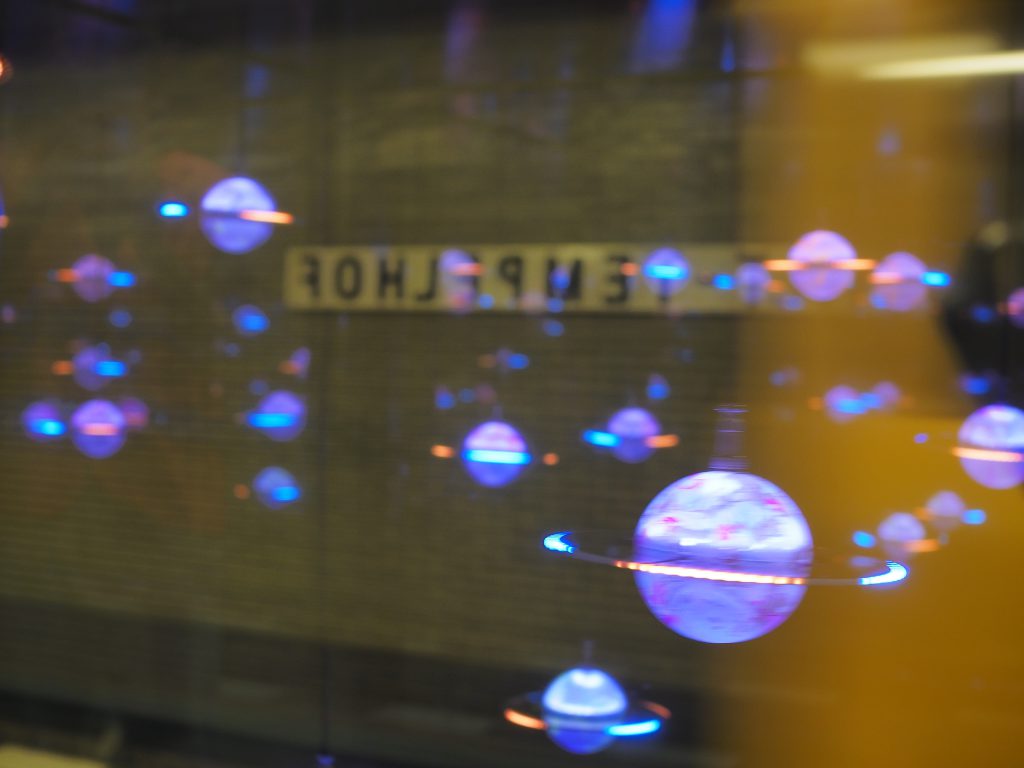
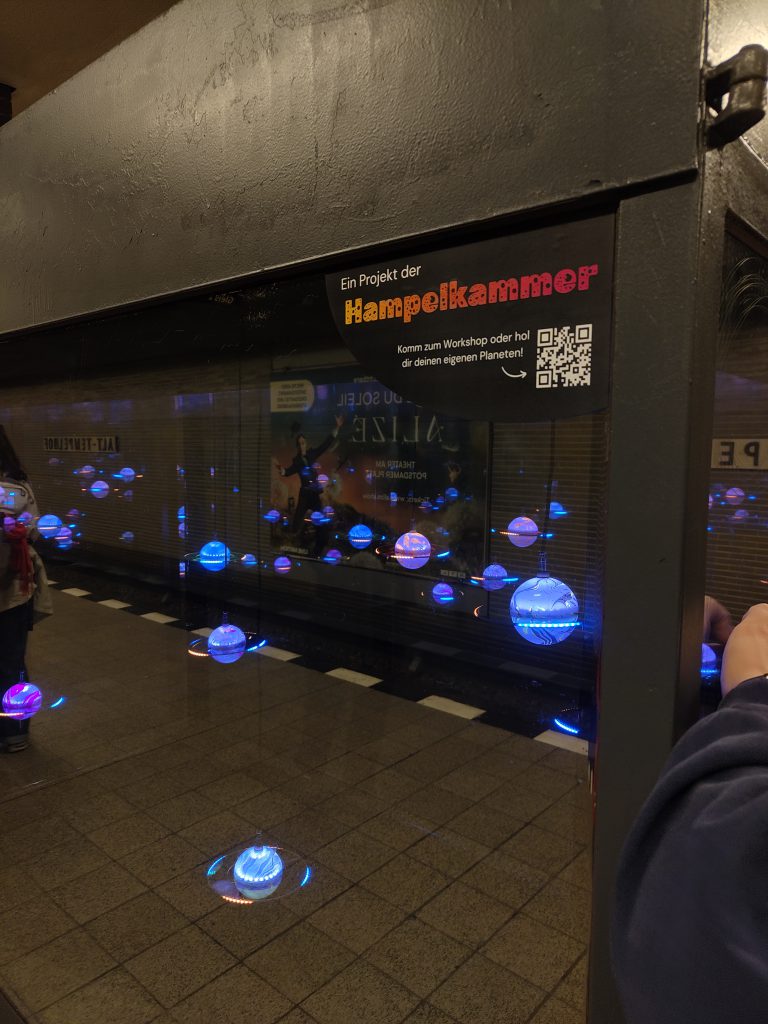
Traumraum Alt-Tempelhof – verspiegelte Vitrine mit schwebenden Planeten
Installationen 2026

Traumraum

Two glowing mini-universes in Berlin subway stations: floating planets in old display cases that turn commuters' everyday routine into a little galaxy for a moment.
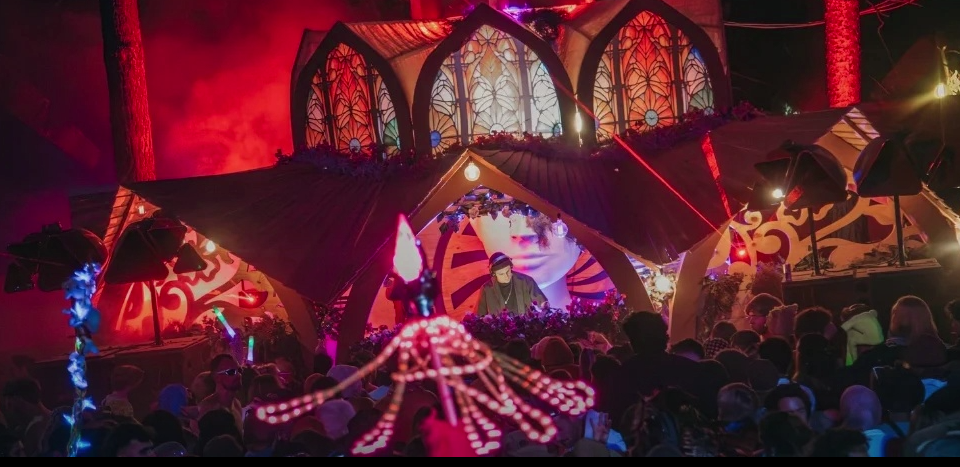
Traumraum is an urban art project I realized for the Hampelkammer collective – funded by the Dezentrale Kulturarbeit in the Tempelhof-Schöneberg district. Over the summer of 2026, two old display cases in the Alt-Mariendorf and Alt-Tempelhof subway stations became two little galaxies in the middle of commuters’ everyday lives. Two cases, two independent installations – one shared idea: to step out of the wait for the subway into another universe, just for a moment.

Alt-Mariendorf

The Mariendorf case – 3.20 m wide, 1.36 m high, 1 m deep – fills with 16 floating planets and two spots. A Raspberry Pi controls the scenes in real time over Art-Net DMX, and 3D mapping gives it spatial depth. What looks like random sparkling is a precisely choreographed play of color.

The special part: the installation invites you to take part. Whoever stands in front of it scans a QR code, connects automatically to the local Wi-Fi, and lands on a small Hampelkammer page. There, three light shows by three Berlin artists are waiting – the matching sound plays directly through your own phone.

Alt-Tempelhof

The Tempelhof case is mirrored on every side – and that’s its whole secret. Seven planets, driven by an ESP32, float through eight light effects. But because the mirrors throw into each other endlessly, floor and walls disappear: seven planets become seemingly hundreds, staggering off into infinity in every direction. A small window with a boundless cosmos behind it – an experience for young and old.

Exterior dimensions: 2.03 m high, 2 m wide, 1 m deep.

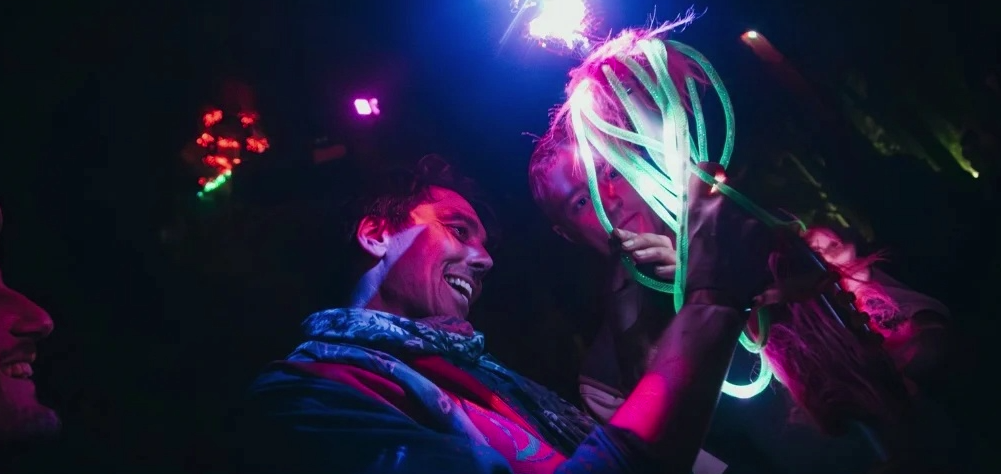
Davids Totem, nachts über der Menge im Wald
Davids Totem im Einsatz auf einer Festivalbühne
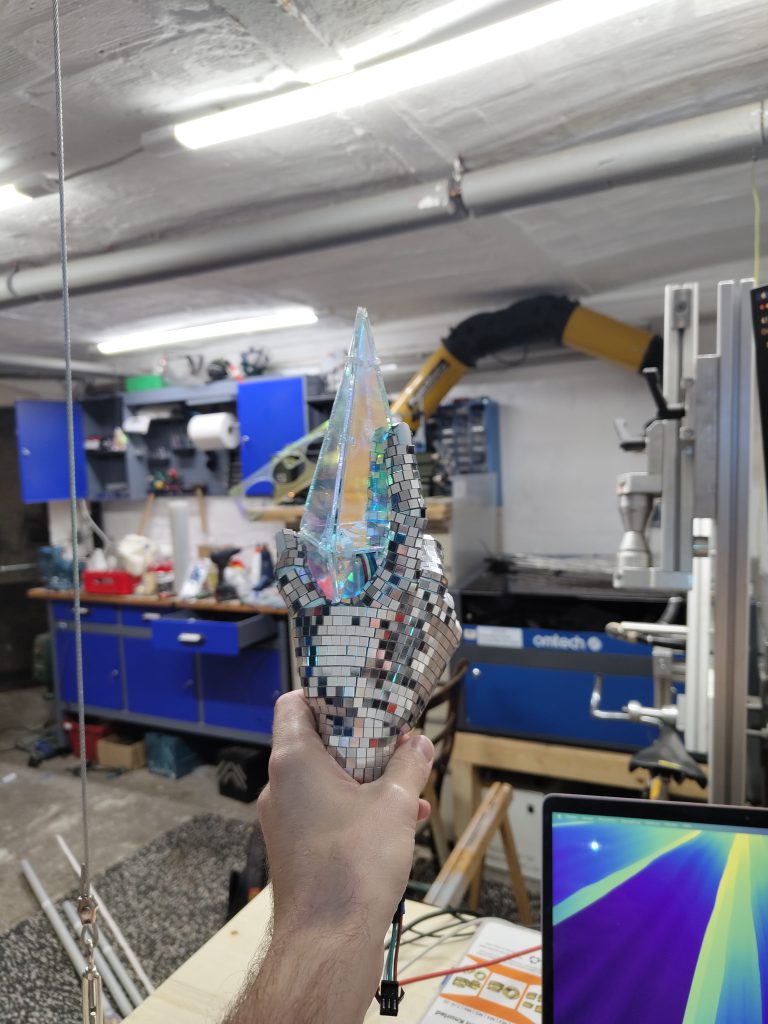
Disko-Hand mit dichromatischem Kristall, Nahaufnahme
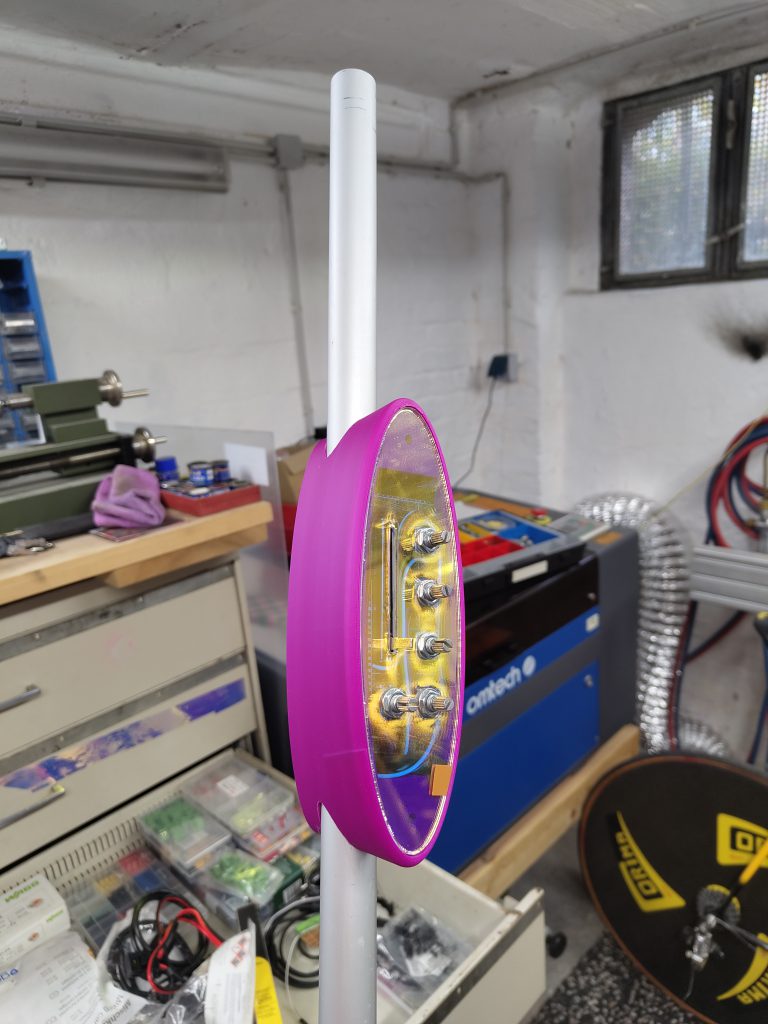
Selbstentwickeltes Steuerpult mit Reglern
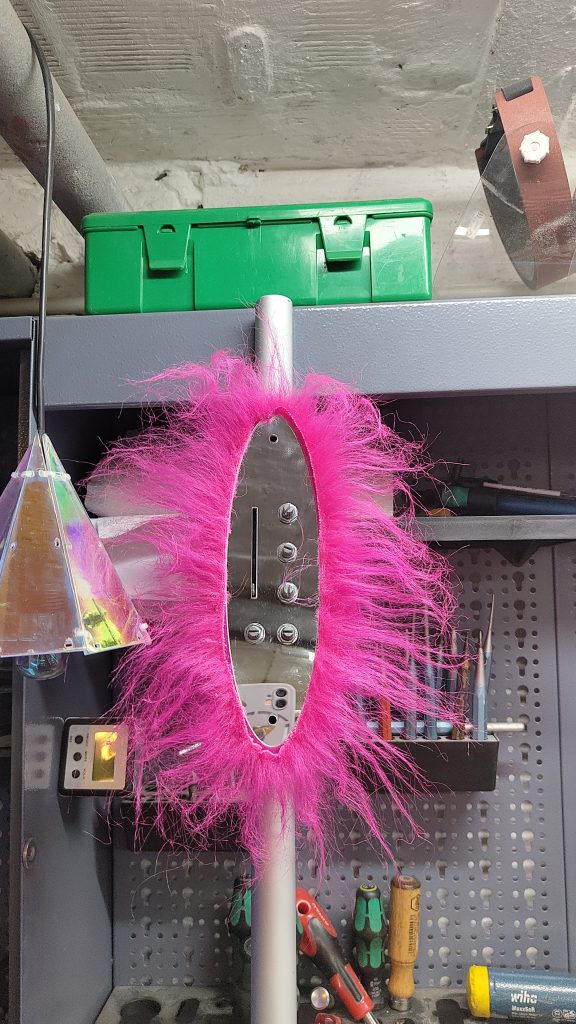
Davids Totem während des Aufbaus in der Werkstatt
Festival-Totems & Objekte 2025

Davids Totem

A custom-built festival totem, made to travel the world: a disco hand with a glowing crystal, rotatable and with hypnotic light effects – controlled via a self-developed panel.
Davids Totem is a commissioned work – and a prime example of how an idea becomes a finished, travel-ready object. David approached me after the closing of Skalar Festival 2025: he wanted a totem that was entirely his own. Over two rounds I presented him three concrete designs; together we settled on one sketch – and then I built it for him.

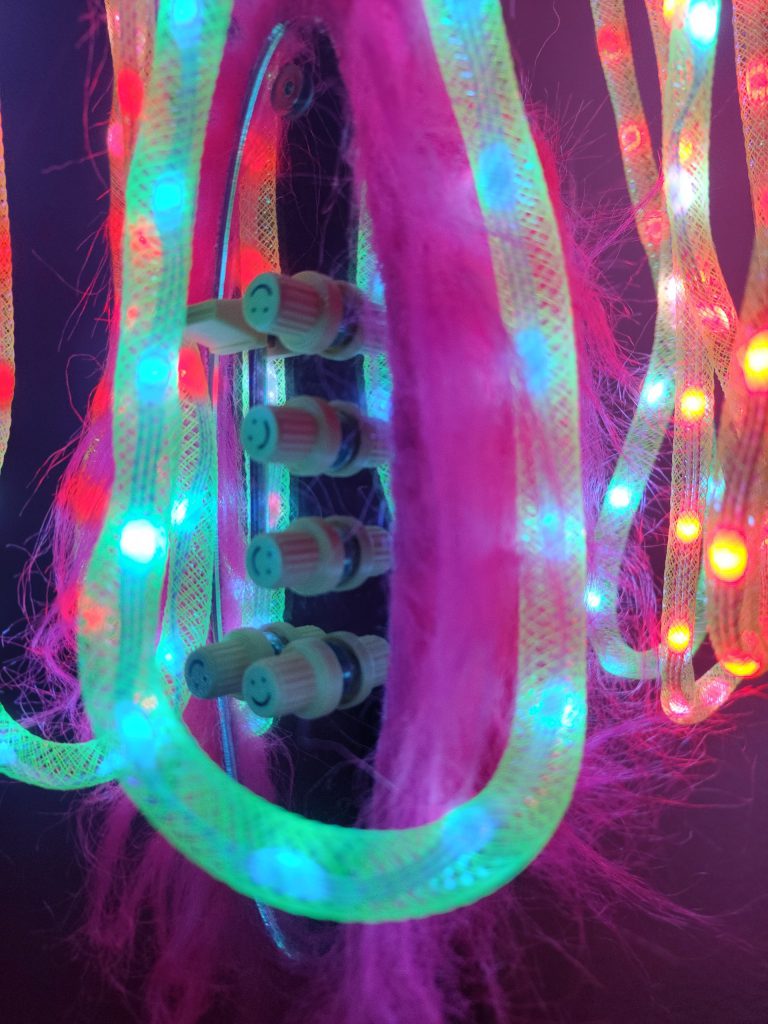
The totem has to travel with David, all around the world. So the brief was clear: light, dismountable, and robust – yet with strong, colorful effects that stand out instantly on the dancefloor. The centerpiece is a disco hand, crowned by a dichroic crystal with two high-power LEDs inside. Below it wind several meters of addressable LED strings.

The real trick is in the movement: David likes to spin his totem – and the light effects are tuned exactly to that. The rotation of the strings creates patterns that run into one another and at times feel downright hypnotic.

Everything is controlled via a self-developed panel with color selection, a brightness dial, an effect switcher, and controls for intensity and speed – so David has his light show in his own hands at all times. An integrated battery holder makes the totem fully self-sufficient.

From the first 3D design to the last component, everything was made in my own workshop: 3D printing, laser cutting, a custom-designed control board, and the matching software. An object that belongs to exactly one person – and travels the world with them.

Gudrun — Little G, LED-Planet
Festival-Totems & Objekte 2025

Gudrun — Little G

The little planet that started it all: 145 freely programmable LEDs.
Little G is a small LED planet with 145 freely programmable WS2812B LEDs – originally built as a gift for a friend. That single planet became the cornerstone for everything that followed: the totems, the Traumraum installations, Cosmic Sinkhole. Every large planet carries a piece of Little G inside it.

Spaceship Cockpit — Fusion, mobile Bühne im Raumschiff-Design
Kollektiv-Arbeiten 2024

Spaceship Cockpit — Fusion

A mobile stage in spaceship design: a cockpit that docks onto a shipping container, with wings that rise on linear motors.

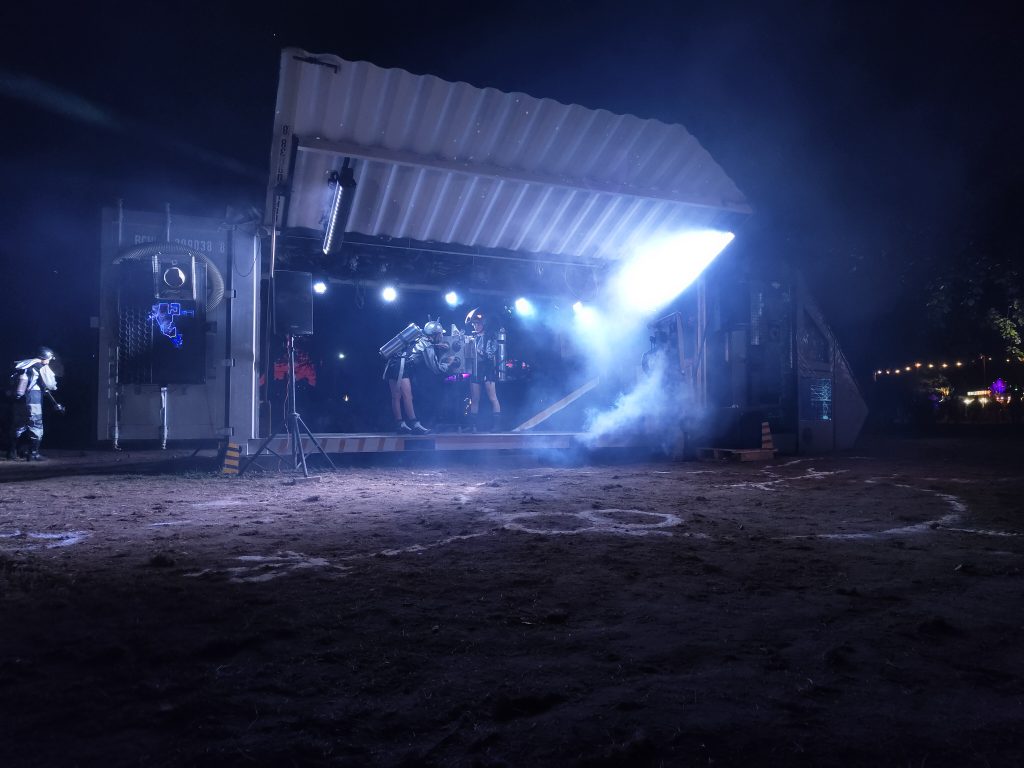
For Fusion 2024 I developed a mobile stage in spaceship design together with the Kollage collective in a joint session. My part was mainly the cockpit: a structure that docks onto a shipping container and breaks down into handy parts for transport – all stowed inside the container itself. The spaceship is raised by linear motors that lift the wings; during operation they can move up and down, bringing motion to the whole stage.

The Spaceship is a real playground: a stage for live performances of theater and acrobatics, a DJ booth in the cockpit – and beneath it, between the wings, people dance.